You just landed a BigLaw job. $225K starting salary. And you're realizing: law school didn't teach you how to dress for this.
For three years you wore whatever to class. Maybe you had one interview suit that you pulled out for OCI and callbacks. Now you're about to work somewhere that expects you to own actual professional clothing—and to look like you know what you're doing in a courtroom.
Here's everything they didn't cover in Professional Responsibility.
The Reality: Day-to-Day vs. Court Days
First, the good news: most BigLaw firms have gone business casual for regular office days. Even Cravath relaxed the dress code eventually.
On a typical day drafting briefs at your desk, you can wear:
- Dress shirt (no tie)
- Chinos or wool trousers
- Clean dress shoes or quality loafers
You won't be in a suit every day.
But you need suits ready for:
- Court appearances
- Depositions
- Client meetings
- Partner meetings with outside counsel
- Pitches and business development
- Anything involving opposing counsel
And your first day? Wear the suit. Every year the new class shows up suited. By afternoon some people ditch the jacket. By day two, most go business casual. But on day one, match the expectation.
The First Suit: Navy, No Questions
If you buy one suit, make it navy.
Not black—that's for funerals. Not light grey—too casual for court. Not pinstripes—you're a first-year, not a name partner.
Navy works for:
- Court appearances
- Client meetings
- Interviews (yes, more interviews—lateral moves happen)
- Weddings
- Anything else where you need to look professional
Navy is the universal answer. When you're not sure, navy is correct.
The Specs
- Cut: Two-button, single-breasted, notch lapel
- Fabric: Wool, Super 100s to 130s
- Fit: Tailored—not boxy, not skinny
- Trousers: Flat-front, slight break or no break
This suit should fit perfectly and look completely unremarkable. You're not trying to be a fashion statement. You're trying to look like a competent professional who understands the stakes.
Fit Is Your Armor
Here's what senior partners know that first-years often miss: in a courtroom, your suit is armor.
When you stand to argue a motion, the judge evaluates you before you speak. Opposing counsel sizes you up. The client in the gallery decides whether they trust you with their case. The psychology of first impressions is ruthless—seven seconds to form an opinion.
A suit that fits signals competence. A suit that doesn't—shoulders that droop, jacket that pulls, trousers that pool—signals the opposite.
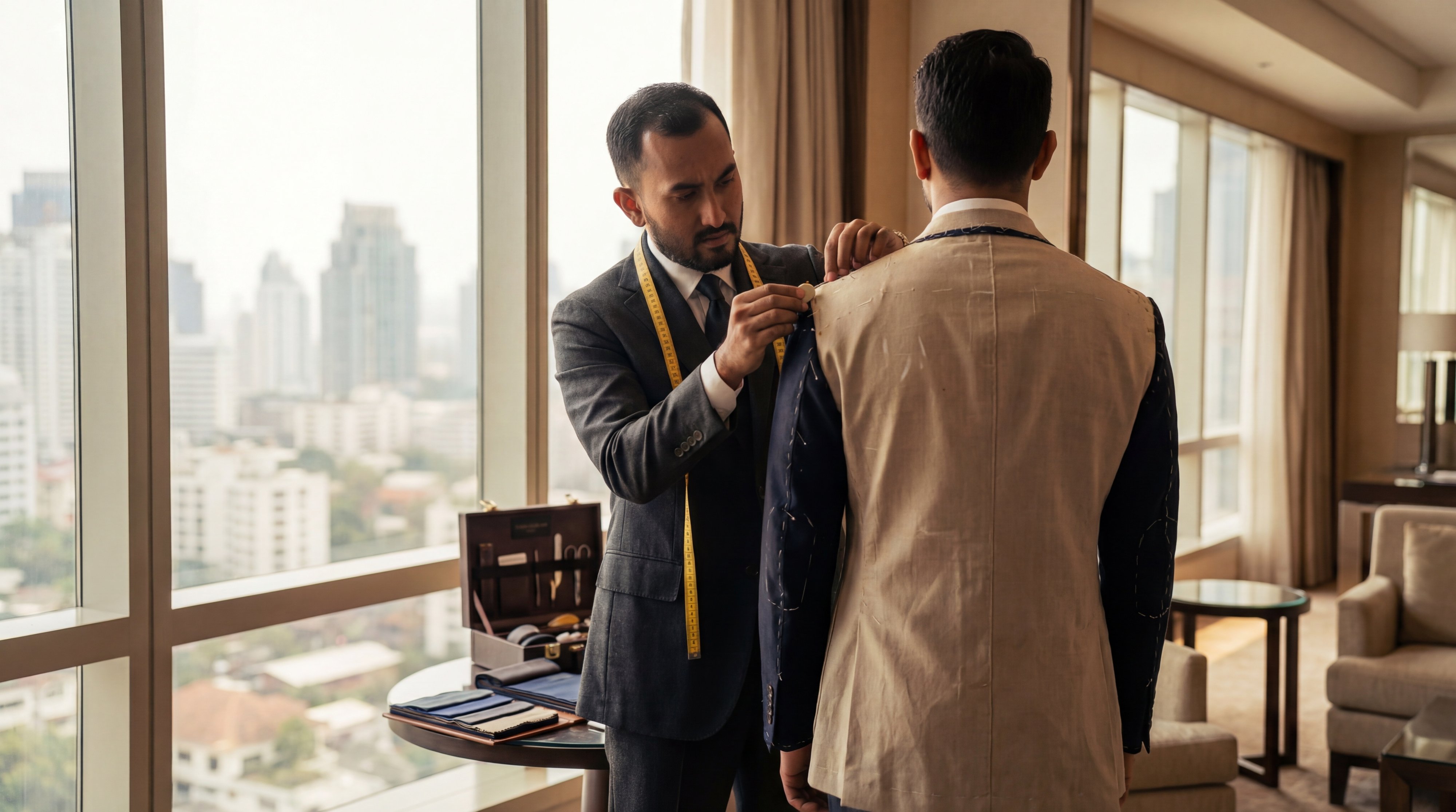
This is why draft fitting matters. Before we cut your final fabric, we send a test garment. You try it on at home, tell us what needs adjusting, and we fix the pattern. The suit that arrives fits because we verified it would.
Off-the-rack suits are designed for average proportions. If you're 6'3" with a swimmer's build, or 5'7" with broad shoulders, or anywhere outside the statistical middle, rack sizes won't fit without extensive alterations.
And even with alterations, certain things can't be fixed. Shoulders that don't fit require complete reconstruction—$200-400 if it's even possible.
Custom with draft fitting eliminates the risk. $650 total, and it fits your body specifically.
Building the Rotation
One suit won't carry you through a BigLaw career. Here's how to build up:
Suit 1: Navy (most versatile, court-ready, client-ready)
Suit 2: Charcoal (slightly more formal, works for everything navy works for)
Suit 3: Light grey (summer, less formal depositions, variety)
Three suits, rotated with at least a day between wears, will last for years. Wool needs time to recover its shape. Wearing the same suit two days in a row accelerates wear.
For fabric options beyond basic wool—linen for summer depositions, tweed for casual client meetings—see our complete fabric range.
The Math: Custom vs. Off-the-Rack
Let's run the numbers:
Off-the-rack route:
- Suit: $800-1,500
- Alterations: $100-250
- Still doesn't fit perfectly because shoulders can't be altered
- Total: $900-1,750 for "good enough"
Custom with draft fitting:
- Suit: $650
- Alterations: included in the process
- Fits perfectly because pattern was verified before cutting
- Total: $650 for exactly right
Custom costs less and fits better. Here's why bespoke quality is now affordable. The only tradeoff is time—3-6 weeks for the process. Plan ahead and the timing works fine.
See the full production timeline.
First Day Specifics
Your first day at the firm:
- Suit (navy, your interview suit is fine)
- White or light blue dress shirt
- Conservative tie (solid or subtle pattern)
- Black leather shoes, polished
- Black leather belt
- Minimal accessories
Watch what everyone else wears that week. By day two or three, you'll understand your firm's actual culture. Some offices are strict business casual. Some are more formal. Some vary by practice group. Observe, then adapt.
Pro tip: Keep a blazer and tie in your office. You never know when a partner will invite you to a client meeting, a court appearance, or a deposition. Being ready is part of the job.
Beyond the Suit: Office Staples
For day-to-day when you're not in a suit:
Shirts: Oxford cloth button-downs, dress shirts in white, blue, light patterns. Keep them pressed. If you're tired of sleeves that are too long or collars that gap, custom shirts solve fit problems.
Trousers: Wool trousers or quality chinos. No jeans unless your firm explicitly allows them (and even then, read the room).
Shoes: Keep two pairs in rotation—black for formal days, brown for business casual. Always polished.
The Emergency Kit: Leave a pressed shirt, tie, and shoe polish in your office. Partners will occasionally need you suited up for a meeting on zero notice.
You're Billing $300+/Hour. Look Like It.
Here's the psychology firms don't discuss openly: clients evaluate their lawyers constantly.
When you walk into a meeting, the client's first impression is visual. They're paying your firm $500-1,000 per hour for the team's time. They expect to see professionals who look serious about the work.
This doesn't mean expensive labels. It means fit, cleanliness, and intention.
A well-fitted $650 suit says: "I pay attention to details." That's exactly what clients want from someone reviewing their contract language or preparing their witnesses.
A rumpled, ill-fitting suit—even an expensive one—says the opposite.
The Long Game
First-year associates become senior associates. Senior associates become counsel or partners. The wardrobe you build now carries forward.
Buy quality. Buy things that fit. Store the patterns (we save yours forever, so reordering is simple). Build slowly rather than buying cheap and replacing constantly.
Five years from now, you'll have a closet of suits that fit perfectly, from fabrics you specifically chose, that you've maintained properly. Meanwhile, the associates who bought fast fashion will be on their third or fourth round of replacements.
One right purchase > three compromises.
Heading into investment banking instead? See our investment banking interview dress code guide.
Get Started
Your first suit should be the last first suit you need to worry about. Navy, perfectly fitted, ready for whatever the firm throws at you.
We'll send the draft. You'll approve the fit. We'll cut the fabric.
No guessing. No hoping. Just precision.